Decompiler Internals Walkthrough
This page walks through how crashlink actually turns HashLink bytecode into readable Haxe-like pseudocode, stage by stage, grounded in the real pipeline code in crashlink/decomp/. It's not a bytecode format reference: for the opcode/type-format spec, see ModDocCE's hlboot docs. This page is about crashlink's own machinery: how a Function's raw ops become a control-flow graph, how that graph gets lifted into an IR tree, how roughly thirty optimizer passes rewrite that tree in a specific order, and how the result gets rendered as text.
If you're about to add an optimizer pass or change lifting behavior, this is the page to read first.
Stage 1: control-flow graph construction
CFGraph.build() in crashlink/decomp/cfg.py (starting around line 126) turns func.ops, a flat list of opcodes, into a graph of basic blocks.
The algorithm is two passes. First it scans every op and records the set of instruction indices that are jump targets: for each conditional jump (JTrue, JFalse, JSLt, etc.), JAlways, and Trap, it computes i + op.df["offset"].value + 1 and adds it to jump_targets; for Switch it adds a target for every entry in offsets. Second, it walks the ops again and splits into blocks wherever it hits one of those jump-target indices (starting a new block), or wherever the current op is itself a block terminator (JTrue/family, Switch, Ret, Trap, EndTrap), ending the current block right after that op. This is standard leader-based basic-block splitting, nothing exotic about it.
Once the blocks (as CFNodes) exist, build() wires up branches between them based on each block's terminating op. Conditional jumps get a "true" edge to the jump target and a "false" edge to the fall-through; note the HashLink convention here: the jump target is taken when the condition holds, and compilers emit the negated source condition, so the fall-through is the "then" arm (this convention resurfaces during lifting). Switch gets one "switch: case: N" edge per case plus a "switch: default" fall-through edge, Trap/EndTrap get "trap"/"fall-through"/"endtrap" edges, and anything else that isn't a Ret falls through unconditionally to the next block.
After the graph is built, build() runs two CFOptimizer passes if do_optimize is set: CFJumpThreader, which collapses blocks that are nothing but a single unconditional JAlways by redirecting their predecessors straight to the target, and CFDeadCodeEliminator, a simple reachability sweep from self.entry that drops unreachable nodes. Both operate purely on the graph shape, before any IR exists.
Jump threading resolves chains before rewriting edges and retargets the entry node. Jump-only cycles, including a one-instruction self-loop, remain in the graph: removing them would erase nontermination.
Finally analyze() computes the structural facts the lifter depends on: predecessors, dominators and post-dominators (iterative fixed-point algorithms, _find_dominators/_find_post_dominators), natural loops via back-edge detection (_find_loops: an edge u -> v is a back edge if v dominates u, and the loop body is everything that can reach u without leaving v's dominance), and immediate post-dominators (_find_immediate_post_dominators). The post-dominator info in particular is what later lets the IR lifter figure out where an if/else's two branches reconverge.
Worked example
tests/haxe/If.hx's main() compiles (f@222 in If.hl) to 15 ops with two JSGte conditionals and one JAlways. Running the disassembler shows the raw shape:
3. JSGte   {'a': 2, 'b': 0, 'offset': 2}   if reg2 >= reg0: jump to 6
4. Call0   {'dst': 1, 'fun': 27}           reg1 = f@27()
5. JAlways {'offset': 1}                   jump to 7
6. Call0   {'dst': 1, 'fun': 220}          reg1 = f@220()
7. Call0   {'dst': 1, 'fun': 221}          reg1 = f@221()
CFGraph.build() sees op 3 (JSGte) as a block terminator and op 6 as a jump target, so it splits into a block ending at op 3, a block {4, 5} (ending at the JAlways), a block starting at 6, and so on. The JSGte node gets a "true" edge to node 6 and a "false" edge to node 4; node 4/5's JAlways gets an "unconditional" edge to node 7. CFJumpThreader would collapse the {4,5} block if it were only the JAlways, but it also has the Call0, so it survives untouched here.
This is the actual graph CFGraph.build() produces for f@222, rendered with IRFunction.to_dot() (the same DOT output the GUI's CFG viewer uses):
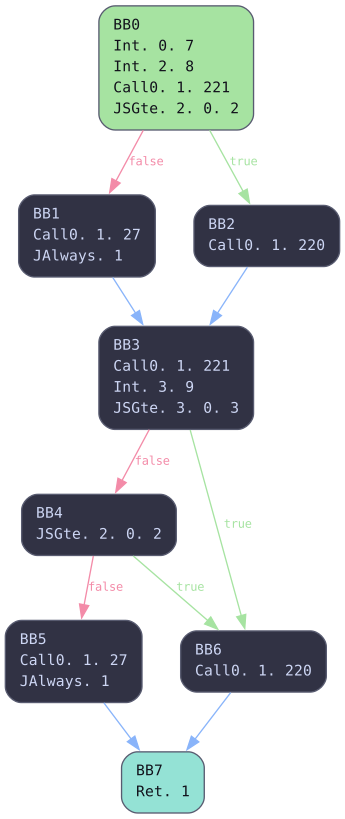
If.main() actually runs two separate if-statements from the source one after another, and the shape shows it: BB0's JSGte is a clean diamond (BB1/BB2 converging at BB3), but the second if reuses part of its own condition logic across two blocks (BB3 and BB4) before both of their branches converge on BB6, then BB7's Ret. Green edges are the "true" branch (jump taken), red are "false" (fall-through), blue are unconditional. This is exactly the "diamond" shape _find_convergence_node has to detect and stop recursing at for each conditional, twice over, in one function.
Stage 2: IR lifting
IRFunction.__init__ (crashlink/decomp/function.py, ~line 217) is the entry point. For a Native function it skips all of this and just wraps an IRNativeStub (no CFG, no ops to lift). For a real function it builds the CFGraph, then calls self._lift(no_lift=no_lift).
_lift() first creates one IRLocal per register in func.regs (var0, var1, ...), then calls _build_assign_map() and _name_locals() before doing any tree construction. _build_assign_map() reads func.assigns (debug info mapping op index -> variable name) and builds _op_assigns: which op index introduces which named local for which register. This matters because HashLink aggressively reuses registers: the same register slot can hold a loop counter, then get recycled as an anonymous temp, then get reused for something else entirely. crashlink handles this with what the code calls an "SSA-esque" split (_split_local, _check_assign): whenever a register's debug name changes, or a named register gets silently overwritten by something that clearly isn't a continuation of its own value (checked by _has_untracked_reuse/_is_continuation_write, which special-cases patterns like i++ and i = i + 1 as not a fresh variable), the lifter creates a brand-new IRLocal for that slot rather than reusing the old one. Without this, an unrelated .length read stored back into a loop counter's old register would print as if it were still the loop variable.
The actual tree construction happens in _lift_block() (~line 1691), called first as self._lift_block(self.cfg.entry, set()). This is a recursive descent over the CFG: it takes a CFNode, a visited set (cycle guard), an optional stop_at node (the convergence point where the current recursive branch should stop), and an optional loop_ctx. Ops in a block that aren't the trailing control-flow op get lifted one at a time by _lift_ops_into_block into IRAssign/IRCall/etc. statements; the trailing op (a conditional jump, Switch, Ret, Trap, ...) decides how the next IRBlock(s) get attached.
For a conditional jump specifically, _lift_block inverts the jump's condition (cond_expr.invert()) because, as noted above, HashLink's jump-on-true-to-target convention means the fall-through is actually the source's "then" branch. It then has to figure out where the two branches converge again so it knows where to stop recursing into each one; this is _find_convergence_node, backed up by the CFG's precomputed immediate post-dominators when the heuristic search doesn't find an unambiguous answer. There's a chunk of gnarly special-casing here worth knowing about if you touch it: the convergence heuristic can pick a branch target as its own convergence point when that target is also reachable via one of the other branch's internal sub-paths (not on every path, just one), which would wrongly treat an inner conditional's shared call as the outer merge point. The code detects this specifically with real post-dominance rather than blanket-overriding every self-referential pick, because the "if with no else" shape legitimately wants the branch target as its own convergence and forcing the post-dominator there would incorrectly pull trailing code into the conditional.
Loops get a separate path: if the target node heads a natural loop (node in cfg.loops), _lift_block defers to _lift_loop instead of the generic conditional handling, which builds an IRWhileLoop/IRPrimitiveLoop and a _LoopContext used to translate loop-exiting branches into IRBreak/IRContinue rather than raw jumps.
tests/haxe/LoopWhile.hx's main() (f@22 in LoopWhile.hl) is a natural loop in graph form:

The back edge is what _find_loops is looking for: an edge into a node that dominates the block the edge comes from. Everything reachable from the loop head without leaving that dominance is the loop body, which is exactly the region _lift_loop has to lift into the IRWhileLoop's body rather than treating it as one more if/convergence pair.
One more thing worth knowing before touching this code: _lift_block memoizes on (node, stop_at, id(loop_ctx)) in self._lift_cache. The comment on this (around line 1726) explains why it's necessary: CFGs where many branches funnel into a shared continuation point would otherwise cause the same region to be re-lifted independently from every branch that reaches it, which is exponential in nesting depth. Cached results are still handed back as clones (self._clone_ir), not the shared instance, because nothing downstream expects an IR node to be reachable from multiple parents. Treating the IR as a real DAG would just move the same exponential blowup into every consumer that walks it.
Opcode-to-IR shape
The opcode-to-IR mapping in _lift_ops_into_block (~line 901) is mostly a big if/elif matched on op.op. A few representative cases: arithmetic ops (Add, Sub, Mul, ...) become IRAssign(dst, IRArithmetic(lhs, rhs, type)); constant-loading ops (Int, Float, Bool, Bytes, String, Null) become IRAssign(dst, IRConst(...)); CallMethod/CallThis resolve the callee through _resolve_method_field and become IRAssign(dst, IRCall(METHOD, field_expr, args)), or fall back to an IRUnliftedOpcode wrapper if the field can't be resolved. One subtlety in _lift_ops_into_block: it snapshots source_locals = self.locals.copy() before checking for a debug-name split on this op's destination, and operands read from that snapshot while the destination write reads from self.locals after the split. This exists because HashLink frequently reuses a register as both source and destination in the same op (reg0 = String.__add__(reg0, reg1)); splitting the destination local first would make the source operand pick up the freshly-split (empty) local instead of the value actually being read.
Numeric operations retain semantic distinctions independently of printed operator
spelling. Signed and unsigned division/remainder are distinct IR operators, and
unsigned integer division is rendered through zero-extended hl.I64 operands to
avoid Haxe's lossy float-to-Int conversion for high-bit quotients. Negated floating
comparisons retain their explicit negation so NaN behavior survives inversion.
I64 operations retain all 64 bits: signed operations use hl.I64 directly, while
unsigned division/remainder use a signed-safe quotient estimate and correction.
Unsigned comparisons flip the sign bit before comparing. Operand evaluations stay
single and ordered, including when the renderer must emit an immediate function.
Stage 3: the optimizer pipeline
Once lifting produces the raw IR tree, IRFunction.__init__ builds self.optimizers, a list of roughly 40 optimizer instances (some pass classes appear more than once with different flags), and runs them in _optimize() (~line 544) by iterating the list, calling o.should_run() first (a cheap early-exit gate many passes implement to skip themselves when their target opcodes/patterns don't appear at all) and then o.optimize().
This list, defined inline in __init__ (~line 251-315), is not sorted alphabetically or by class name; it's an intentionally ordered pipeline, and a few of the orderings are load-bearing enough that the source comments call them out explicitly. Grouping the ~40 entries conceptually:
Control-flow restructuring first. IRBlockFlattener and later IRElseFlattener clean up nesting artifacts from lifting (an else branch that's itself just a single nested if collapsing into an else if, for instance). IRConstructorFolder and IRPrimitiveJumpLifter run early too, before anything downstream has a chance to obscure the raw shapes they're matching.
Condition and jump simplification. IRGlobalStringOptimizer, IRStringIntConcatOptimizer, IRConditionInliner, IRArrayGrowGuardEliminator, IRLoopConditionOptimizer, IRSelfAssignOptimizer, IRRedundantContinueEliminator clean up how conditions and jumps got lowered before the bulkier copy-propagation and inlining passes run.
Copy propagation and temp inlining. IRCopyPropOptimizer runs first, then later IRTempAssignmentInliner runs twice, once conservative (aggressive=False) then once aggressive (aggressive=True). The class docstring spells out the difference: conservative mode only inlines temp = expr into the immediately following statement's use of temp; aggressive mode inlines "safe" expressions (constants and similar) into all subsequent uses as long as the temp isn't redefined in between. Running conservative first and aggressive second lets the cheap, narrowly-safe fold happen without accidentally being blocked by the aggressive pass's broader substitution reach, then the aggressive pass mops up what's left. The pass never touches a variable that has an explicit debug name from the source; it only targets compiler-generated temporaries.
Dead code and dead temp elimination. IRStringAllocOptimizer, IRSequentialTempFolder, IRDeadTempEliminator, IRDeadCodeEliminator run after the first inlining round to clean up assignments that inlining just made unreachable or unused.
Discarding a value is not permission to discard its evaluation. Dead-value cleanup and general inlining share a conservative effect classifier: unknown/native/indirect calls, allocations, checked casts and potentially throwing memory reads are not assumed harmless. These expressions may remain as temporaries or standalone evaluations instead of being discarded, duplicated, or moved across control flow.
Array/collection pattern recognizers, deliberately positioned after temp inlining. IRArrayPatternOptimizer, IRNativeArrayAllocOptimizer, IRArrayObjWrapperOptimizer, IRNativeMapAllocOptimizer, IRBytesAllocOptimizer run only once the earlier inlining passes have collapsed multi-register lowering sequences into a single expression shape these optimizers can pattern-match. IRArrayPatternOptimizer's own docstring says as much: it recognizes low-level patterns like "fixed-size integer array literal built with alloc_bytes + stores + allocI32" or "temp = arr.bytes; ...; x = temp[idx << 2] -> x = arr[idx]", and that second pattern only exists as a matchable shape once temp has actually been folded away by the inliner.
There's then a second, later round of IRTempAssignmentInliner calls (aggressive=True, past_kills=True immediately followed by aggressive=False), with a comment explaining they run "only after the pattern optimizers" because those optimizers match raw lowering shapes that an earlier inlining pass would have already disturbed. past_kills=True here means a later redefinition of the temp bounds the substitution range instead of blocking inlining outright, a looser rule than the first round used.
Right after that, IRArrayObjBoundsCheckCollapser runs, and its own comment is explicit about why it has to come here: "only after temp inlining has folded the register chain into a single this.field.array[idx] shape for it to match." The same pass runs again much later in the list (this is the "late second pass" comment near the end), because in larger functions that this.field.array[idx] shape doesn't fully materialize until after loop/switch restructuring and the cleanup passes that come after the first pass have had a chance to run. This double placement is the kind of thing that looks redundant until you trace through why a single placement isn't enough: the shape genuinely doesn't exist yet the first time some functions reach that point in the pipeline.
Another explicit ordering comment sits around IRTempAssignmentInliner(self, aggressive=False), re-run right after IRTraceOptimizer: the comment explains that trace()'s DynObj scaffolding collapsing brings a dead user-local-register reassignment adjacent to its sole use for the first time, so the inliner's user-local-reuse fold (in _visit_block_conservative) can now see and fold something it couldn't see before that collapse happened.
Switch, loop, and higher-level reconstruction near the end. IRIntSwitchOptimizer, IRStringSwitchOptimizer, IREnumSwitchOptimizer turn chains of equality-compare-and-jump into IRSwitch nodes; IRLoopRerollOptimizer, IRForEachLoopOptimizer, IRIntRangeLoopOptimizer recognize while-loop shapes that are actually a for loop or a for..in iteration and rewrite them into the more specific IRForEachLoop/IRIntRangeLoop nodes. These run late because they depend on the conditionals and temps around them already being in their cleaned-up final form.
Final cleanup pass. IRDeadStoreEliminator, IRDeadAssignmentEliminator, IRGuardOrMerger, IRRedundantRecomputeEliminator, IREmptyConditionalNormalizer, IRTerminalValueInliner (run twice), and the late IRArrayObjBoundsCheckCollapser mentioned above sweep up whatever the structural passes left behind.
After the built-in list, __init__ splices in any plugin-registered optimizers (crashlink.plugins.optimizers_for), gated per-image and cached on the Bytecode object via self.code._plugin_optimizer_classes so the gating check only runs once no matter how many functions in the same image get decompiled.
If capture_layers=True was passed to IRFunction, _optimize() records a pretty-printed snapshot of the whole block after every single pass into self.layer_snapshots, tagged with whether the pass actually ran (should_run() can skip it). This is what backs any "show me the IR after pass N" tooling; it's plumbing for observability, not part of the transformation logic itself.
Worked example: array pattern lowering
tests/haxe/ArrayAccezz.hx's main() does var a = ArrayAccezz.array(); var b = a[0];. The raw disassembly (f@22 in ArrayAccezz.hl) shows what a single a[0] read actually lowers to in HashLink bytecode: a null check, a bounds-guard comparing the index against a.length, and on the guarded path a Field load of the array's raw .bytes, a Shl to scale the index by the element size, and a GetMem to actually read the byte. That's six ops and a branch for one array read:
1. NullCheck {'reg': 0}                            if reg0 is null: error
2. Int       {'dst': 2, 'ptr': 0}                  reg2 = 0
3. Field     {'dst': 3, 'obj': 0, 'field': 0}      reg3 = reg0.length
4. JULt      {'a': 2, 'b': 3, 'offset': 2}         if reg2 < reg3: jump to 7
...
7. Field     {'dst': 4, 'obj': 0, 'field': 1}      reg4 = reg0.bytes
8. Int       {'dst': 3, 'ptr': 1}                  reg3 = 2
9. Shl       {'dst': 3, 'a': 2, 'b': 3}             reg3 = reg2 << reg3
10. GetMem   {'dst': 2, 'bytes': 4, 'index': 3}    reg2 = reg4[reg3]
By the time this reaches IRArrayPatternOptimizer, the earlier optimizer passes (copy prop, temp inlining, bounds-guard simplification via IRArrayGrowGuardEliminator) have already folded the intermediate registers down to something close to a single this.bytes[idx << 2]-shaped expression, which is exactly the "conditional arr.bytes[idx << 2] load with length guard" pattern the docstring describes. IRArrayObjBoundsCheckCollapser and IRArrayPatternOptimizer fold this whole shape back into a plain array index. The final pseudocode output is just:
class ArrayAccezz {
    public static function main(): Void {
        var a: Array<Int> = ArrayAccezz.array();
        var b: Int = a[0];
    }
}
which is a good illustration of how much of the optimizer pipeline's job is un-lowering: most of these passes exist to recognize a multi-op, guard-and-index HashLink lowering and fold it back to the single high-level expression a Haxe programmer actually wrote.
Worked example: conditional lifting
Going back to If.hx's main() from the CFG example above: after lifting, the two JSGte conditionals become IRConditional nodes with inverted conditions (source b < a compiles to a JSGte that jumps to the else-block when b >= a, so the lifter inverts it back to b < a for the then-branch). The full pipeline output for this function:
class If {
    public static function main(): Void {
        var a: Int = 500;
        var b: Int = 10;
        If.spacer();
        if (b < a) {
            If.other();
        } else {
            If.other2();
        }
        If.spacer();
        if (a > 400 && b < a) {
            If.other();
        } else {
            If.other2();
        }
    }
}
The second if is a case where IRConditionInliner (or a related boolean-merging pass) has folded two separate JSGte guards (a > 400, checked via a jump to the same else-target as b < a's failure) into a single && expression, since the raw disassembly shows those as two independent conditional jumps to the same target (op 9 and op 10 in the disassembly both jump to node 13) rather than one compound condition.
Stage 4: pseudocode rendering
crashlink/pseudo.py is the last stage: it walks the final, fully-optimized IR tree and renders Haxe-like source text. The module docstring is one line: "Pseudocode generation routines to create a Haxe representation of the decompiled IR," and that's accurate, this module doesn't do any further semantic transformation, it's a renderer.
pseudo(ir_func: IRFunction) -> str (~line 1997) is the per-function entry point; it delegates to pseudo_oplines(), which does the actual rendering via _generate_function_pseudo_mapped and wraps the result in a synthetic class { ... } block for context (crashlink infers the class name from the function's proto/field registration, or falls back to the first argument's type if it looks like a this receiver). It also returns a body-relative opcode-to-line map for tooling that needs to point back from a rendered line to the originating opcode, noting explicitly that the map is partial since optimizer-created statements have no source op to point back to.
class_pseudo(ir_class: "IRClass") -> str (~line 3373) is the whole-class entry point, recursing over referenced classes so a single class can be pretty-printed as a standalone, plausibly-recompilable Haxe file. The real per-class rendering work happens in _class_body, which class_pseudo and the flat whole-file decompile_file path both call into; its docstring is explicit that this is "the single place class bodies are rendered" so the two call sites stay in sync rather than duplicating rendering logic.